That's got to be Joel Embiid. I mean, if not, he should be ashamed given his physical gifts.
 Offline
Posts
-
RE: KU trivia to beat summer doldrums
-
RE: Nature
Lindley Hall is getting a major renovation. The Tombaugh Observatory sits atop the roof and I hope they will keep that (and maybe update it as well). I used to go there as a kid and it fueled my in interest in space and astronomy.
I entered KU in 1983 with a dream of pursuing Astrophysics but detoured after Calc 1&2 kicked my ass. (My rural Kansas public school education did not prepare me well in Math.)
But, more to the topic: I was not at all surprised when Pluto was re-categorized as a dwarf planet — and not disappointed.
As a kid, I thought its eccentric orbit (it crosses paths with Neptune and is occasionally closer to Sun than Neptune) and irregular elliptical suggested that it was exogenous to our solar system. Astronomers didn't have any good explanations for these irregularities, and I felt it was most easily explained by a scenario where our sun drifted close enough to another star to pull a distant satellite away.
So, even though Pluto doesn't have planetary status, I think it should be recognized as unique gift to our solar system.
-
RE: KU trivia to beat summer doldrums
btw, Lagerald Vick in trouble with the law.. SMH
-
RE: KU trivia to beat summer doldrums
@rockchalkjayhawk Guessing Wiggins, has the higher rate of 3s and will overtake Marcus, but maybe Marcus has more as of now as he has a few years on Wiggins
-
RE: 2026 KU Season
My barber is a big college baseball fan... he used to go to Omaha every year for the CWS for maybe a decade... anyway, we were talking back when KU was in the regionals and he said the winner of CWS was almost always a team that just got "hot" for the run.. It was rarely a team that was projected to win it all. It's a bit strange to think of baseball being so streaky given that it's not a single-game elimination tournament.
-
RE: Nature
@RockChalkinTexas-0 said in Nature:
One thing I miss in Texas is BIG trees like what grow up in Kansas. I have always wanted to see these majestic trees and have never gotten to.
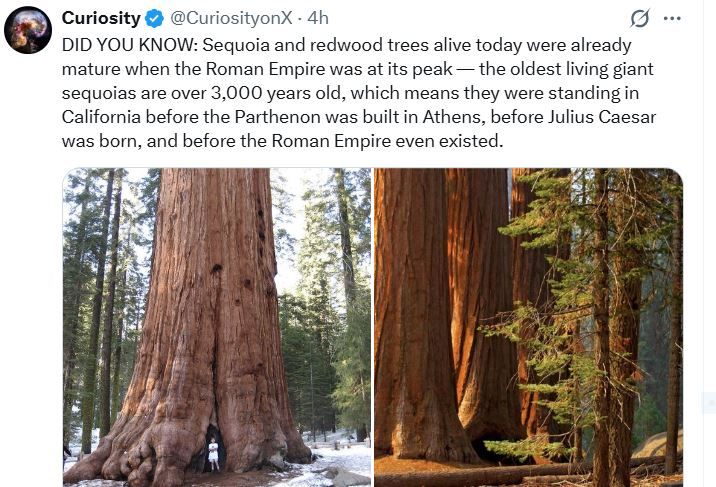
I can attest that the Redwoods and Giant Sequoias are spectacularly huge, majestic and awe-inspiring.
There is a property a couple blocks from me that has 3 redwoods on it and was recently bought by a developer who razed the classic mid-century house and is squeezing in five rental units. I've been pretty concerned that the development will put one or more at risk... It's really sad because those trees have been there since before Columbus discovered the new world.
I'm generally not a tree-hugger, but trees that are more than 500 years old should be considered national treasures.
-
RE: NBA Draft Day!!
AJ goes first.
Making me wonder why he only worked out with the Wizards... The cold shoulder to the other teams could make him drop significantly.
-
RE: Nature
@RockChalkinTexas-0 You have to wonder how evolution lead to the Sotol being almost two entirely different kinds of plants -- a low ground shrub-like feeder and then a 12 ft high 'bloom'. I mean, I guess it has to do with the need to preserve the seeds... but other plants have the same need. It's just pretty unusual.
Also-- huge Carl Sagan fan here. Probably my most admired person I met in person.
-
RE: 2026 KU Season
It ain't over til it's over. It's a brand new day. A new week. Maybe a new lease on the season. Let's see if they can compete and catch OU off-guard.
-
RE: KU ROSTER 2026-27
Stokes and Kinney in the backcourt is sounding better and better. Ah, what might have been with Flory in the frontcourt... If only..
-
RE: KU ROSTER 2026-27
And what of Milan Momcilovic who also withdrew from the NBA draft? There was a time that his list included KU...
-
RE: Shades of Squeeky and his "We won the we-try-harder"
Not everything that can be counted counts, and not everything that counts can be counted.
-
RE: Roll Call
Just getting back on the site after about a month. My excuse for my absence is like others... I lost my dad on May 3. At 91, he had plenty of good years and was probably more ready than the rest of us.
He complained of pain (more than normal) in March and April. My mom had a lot of tests lined up. But when he collapsed in his bathroom on April 22 they found his pelvis had a fracture that had been there for a while... and they found lots of lesions, which had weakened the bone. They accelerated the tests and found his skeleton riddled with metastases. Turned out to be advanced metastatic prostate cancer, which is what I was diagnosed with 10 years ago.
How, you ask, did my dad's rapidly rising PSA (7.7 in 2023 to 288, a few days before he died) go undetected?? Apparently his urologist decided it was ok to stop testing his PSA in 2023. By the time his cancer was discovered from the scans, he was dead before the biopsy results came back.
The moral of the story is: GUYS, get your PSA checked regularly and DON'T let a doctor talk you out of it. They are cheap. There is no good reason to not track PSA.
My cancer was not caught early because of a recommendation by the US Preventable Services Task Force ruling in 2012 advising against routine PSA screening for all men. The USPSTF significantly changed its prostate cancer screening guidelines in May 2018. Too late for me and many other men across this country. The harm is incalculable. Still, I've been fortunate to manage it for nearly 10 years with the amazing medical care at a Cancer Center of Excellence.
-
RE: KU ROSTER 2026-27
@approxinfinity said in KU ROSTER 2026-27:
They’ll keep expanding the tournament field dont worry. We can make it past the first weekend soon hahaha
I actually think expansion will lead to more first round upsets and make it harder to advance. The really weak teams get weeded out in the play-in games.
The play-in teams competed pretty well over the years; some getting to the final four (once at our expense)
-
RE: KU ROSTER 2026-27
If Stokes committing is Plan A, what is Plan B?